Soil Amelioration
Acidity. Sodicity. magnesic soils. Compaction. Salinity. Non-wetting.
Around 77% of Australian cropping soils carry at least one, but they usually co-occur, and are stacked at different depths.
They compound every season.
AND cost Over $1.3 billion a year, sector-wide.
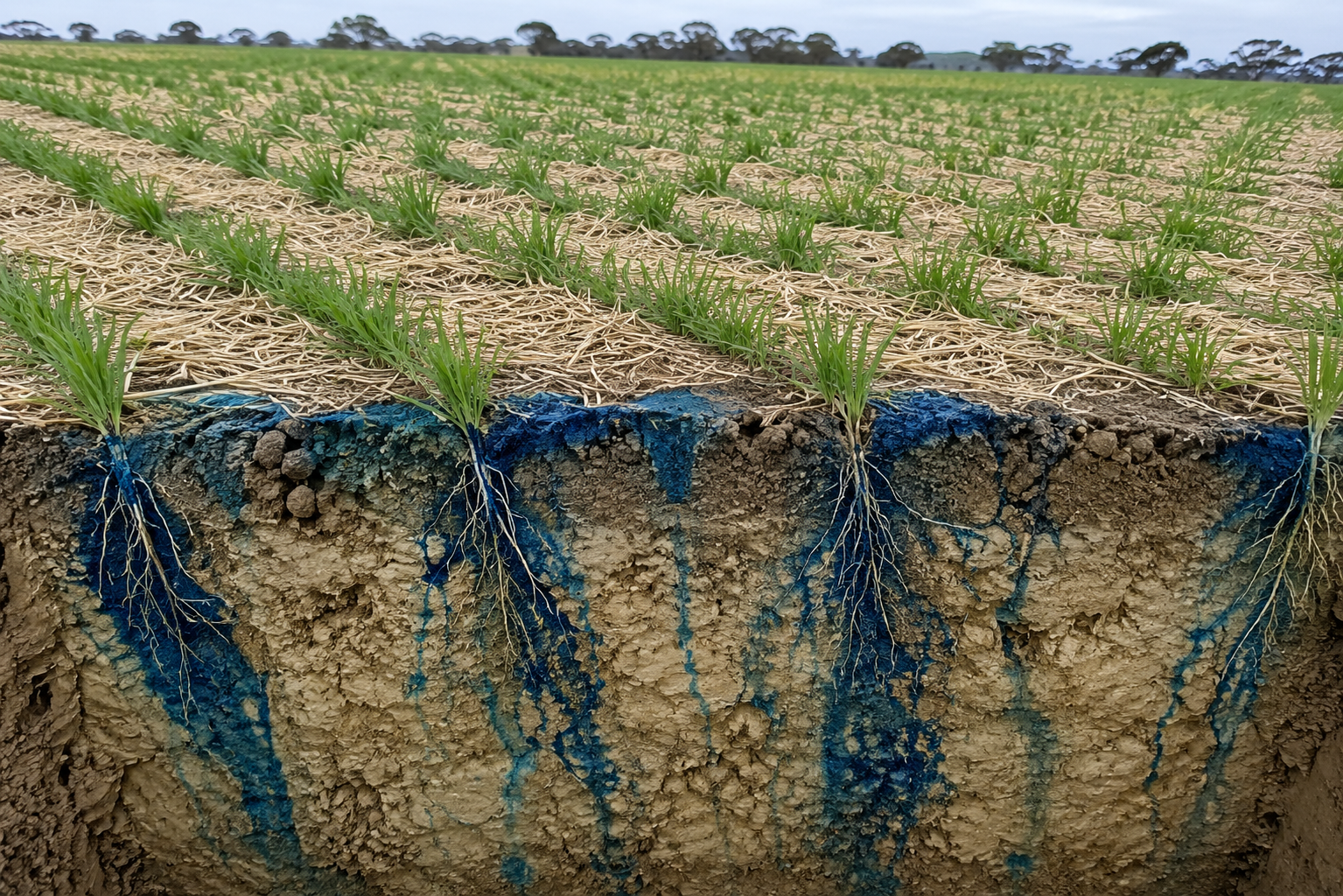
Surface-spread amendment relies on rainfall to carry it down the profile to where soil constraints sit. In low and medium rainfall zones, there often isn't enough water moving through the profile to get it there in time for a return.
Effective soil amelioration starts with finding exactly where the problem is, then designing a delivery method that reaches it, when you need it.
Where constraints stack, the order you treat them in changes the return. That needs a multi-year plan, adapted season by season as the system responds, and someone who can tell a real change from a good year.
Scroll across to learn about What’s limiting your productivity
-
![]()
Non-wetting soils
Non-wetting develops when hydrophobic organic compounds from plant residues, roots and microbes accumulate in sandy topsoil. Coarse sand has very little grain surface area, so a small amount goes a long way. Most WA repellent soils sit under 3% clay in the surface.
It isn't permanent. Repellence is expressed below a critical water content and disappears once the soil is wet. Hot dry summers build it, cool humid conditions at the break maximise it, which is why it bites hardest at seeding.
Water bypasses dry repellent soil and runs down whatever pathways it can find: furrows, old root channels, wetter patches. Part of the profile wets to depth while the topsoil beside it stays dry. That gives you staggered establishment, weeds in waves, and pre-emergent that concentrates in the wetted pathways instead of spreading evenly.
Severity varies within a soil type at a finer scale than soil maps resolve, so we measure it directly rather than assuming a paddock is uniform.
Working with the furrow
Water follows established pathways, which makes seeding placement a cheap management tool.
Seeding on last year's row reuses a furrow that already wets, but the wetted area never expands and trash concentrates.
Using techniques like offsetting seeding angle by around 15 degrees each year can partly address this constraint, with little cost. Furrows cross previous rows rather than running down them, so trash flows and each pass intersects existing wet pathways. Over several seasons the crossings build a network rather than parallel lines, and wetted zones stay moist longer. It rules out controlled traffic, and has to be balanced against contour on sloping ground.
Beyond placement
Wetting agents are low-risk but usually small and inconsistent. Claying works where clay is accessible. Inversion buries the repellent layer outright. Placement manages the problem season to season, capital changes the soil, and we match spend to severity.
-
![]()
Compaction
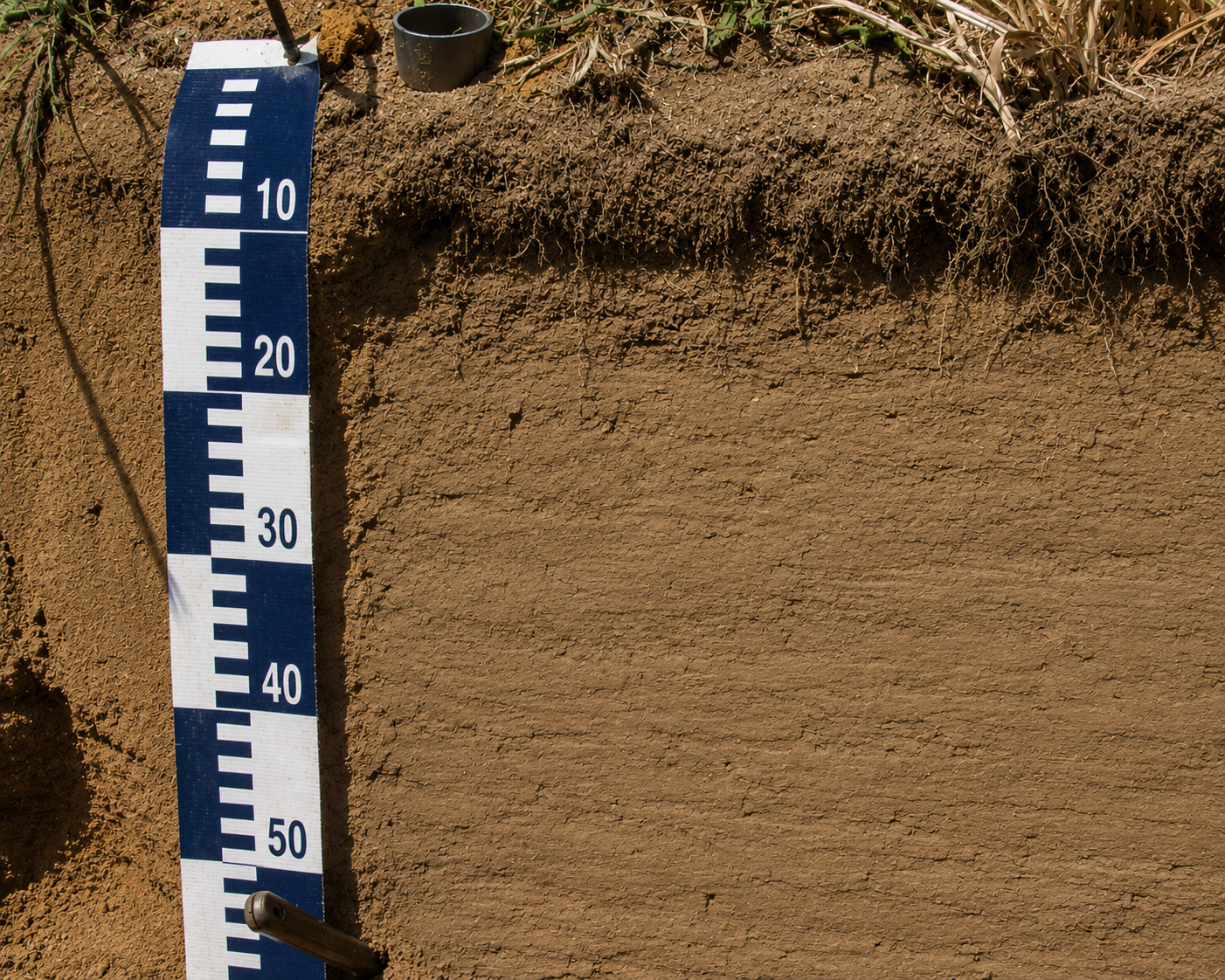
Compaction happens when machinery, stock or cultivation pack soil particles closer together. This collapses the pore space that roots, water and air need. In sands, it shows as a traffic pan at a consistent depth, just below where the seeder reaches. A paddock looks fine on top while carrying a hard layer a spade's depth down, which is why it gets missed until yield or waterlogging patterns give it away.
Traffic isn't the whole story, and this is why ripping often doesn't last. Many WA sands also hardset. When the soil wets, fine material is released between the grains, and as it dries it settles at the grain contacts and ‘locks’ them together. The layer sets hard within days of drying past a critical point. Ripping resets the packing but leaves the fine material in place, so the bonds re-form on the next wet-drying cycle. Compaction is a density problem, hardsetting is a bonding problem. They need different answers.
That changes what controlled traffic can do. CTF stops new pans forming and is worth doing, but it can't remove existing compaction and does nothing about hardsetting, because machinery never caused it.
Duplex sands behave differently again. Ripping depth is limited by how deep the sand goes, ripping into a sodic B horizon can drag dispersive clay into the topsoil, and the sand–clay boundary perches water, so the same paddock can waterlog in winter and set hard in spring.
We measure strength in situ at a recorded water content, because a hardsetting layer read dry looks far worse than it is and read wet looks like nothing. We pair that with bulk density and depth to clay. From there the question is whether loosening alone is worth it, or whether the layer needs something incorporated to change how it behaves on drying.
-
![]()
Acidity & aluminimum toxicity
Acidification is continuous. Ammonium fertilisers, root exudates and alkalinity removed in grain all push pH down every season.
It works downward over decades, so profiles stratify. The top few centimetres can sit above pH 6 on residual lime while the 5 to 15 cm zone drops to pH 4.0 to 4.8. That is exactly where seed and starter fertiliser go, and standard 0 to 10 cm sampling averages the two and hides it. In WA it often runs past 30 cm, and surface lime moves down slowly enough that it can take years to get there.
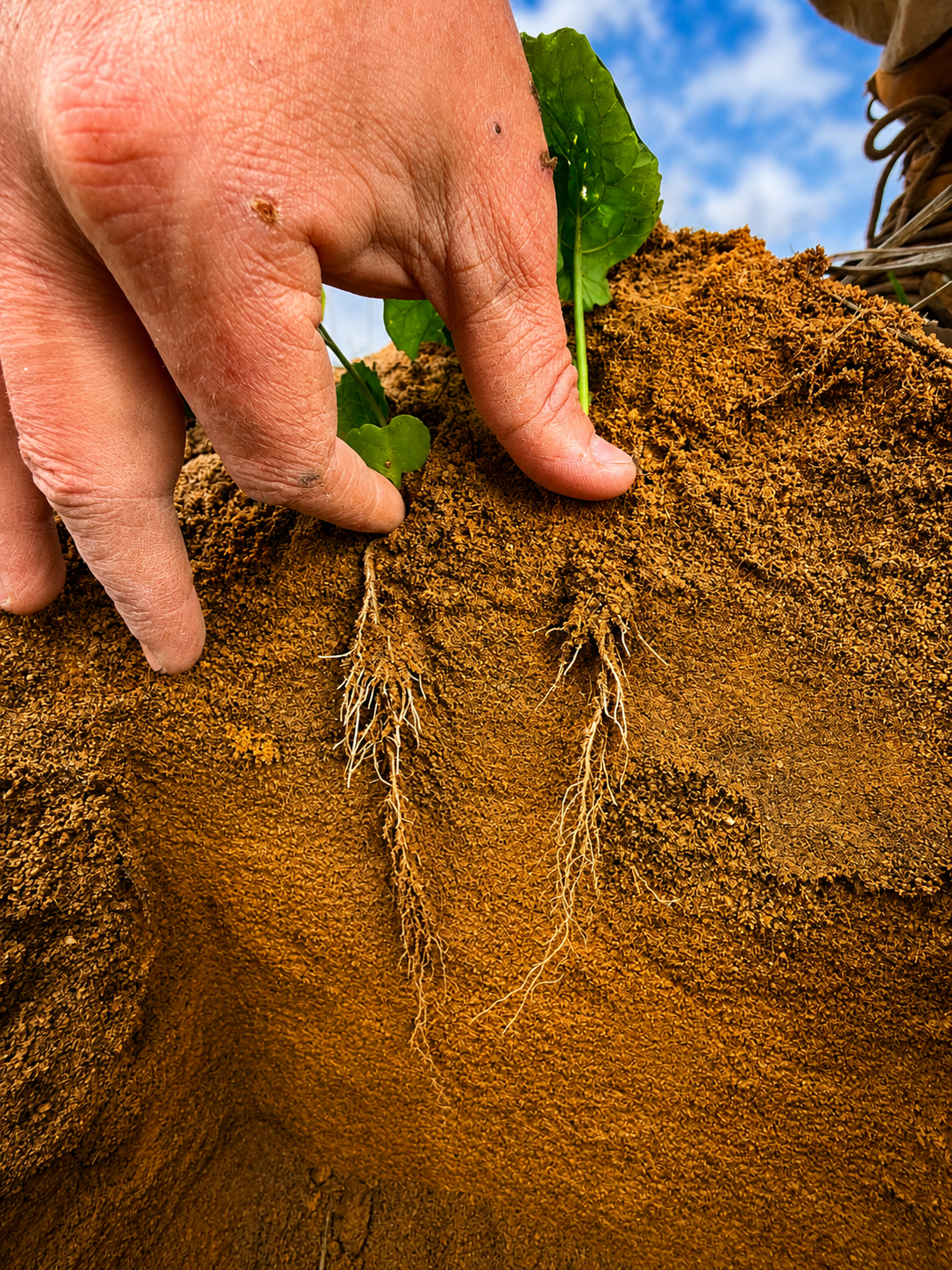
Below about pH 4.8 (CaCl₂), aluminium moves into soil solution as Al³⁺ and becomes directly toxic to roots. It hits the root tip first, stalling elongation then division, so roots stop at the depth where aluminium turns toxic. The plant looks fine above ground while its roots are shut out of subsoil water. That is why acid subsoils usually present as moisture stress. The water stress is real, it just isn't the cause.
We measure pH and exchangeable aluminium at each depth increment, because surface pH tells you little about what sits underneath. Two paddocks with similar topsoil pH can carry very different aluminium loads below 10 cm.
-
![]()
Salinity
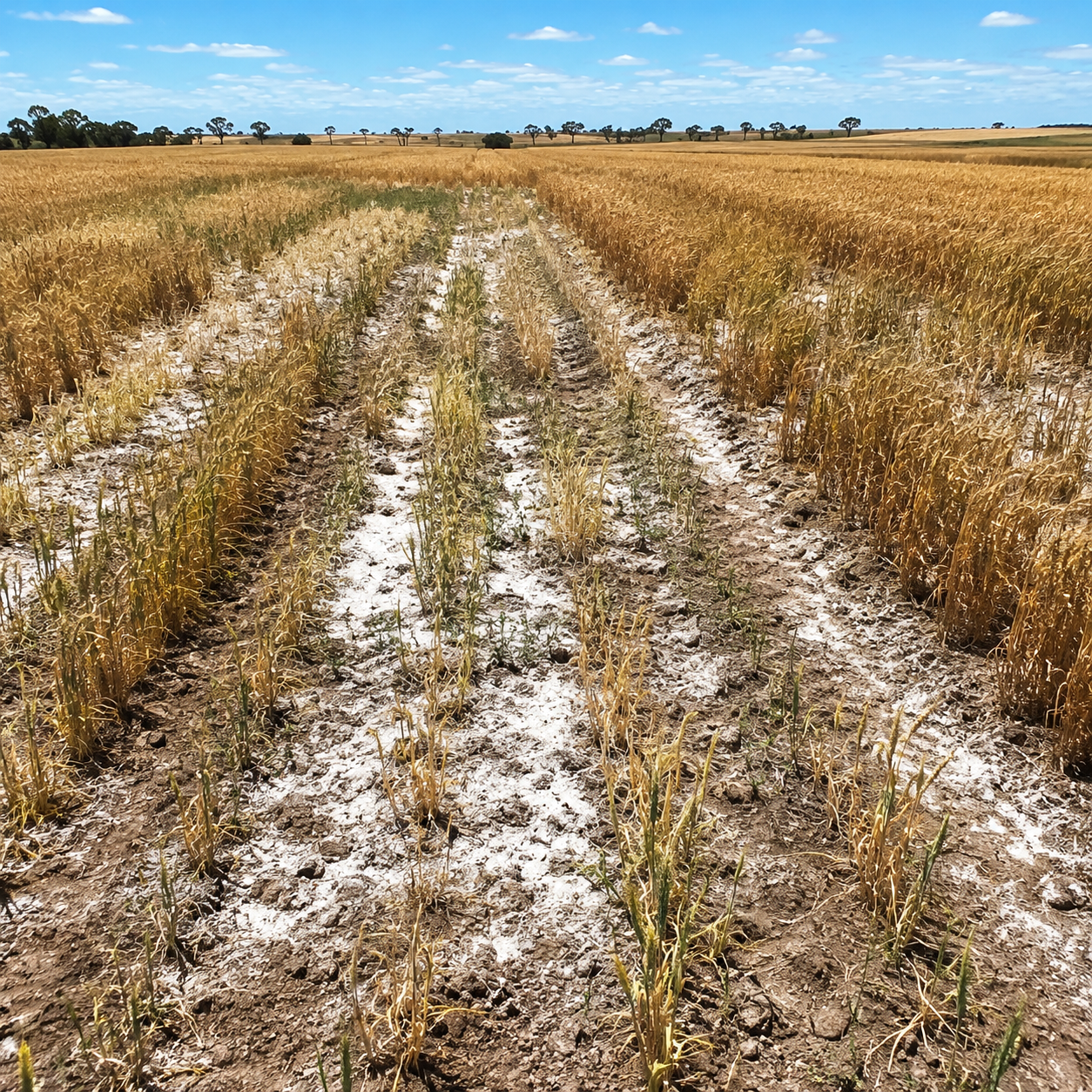
Salinity limits water uptake even when the soil looks moist. Salt holds water more tightly than roots can pull it, so the plant sits in wet soil and still runs out of water.
In the WA wheatbelt, the salt is ancient. Ocean spray deposited in rainfall over tens of thousands of years, held deep in the profile under perennial native vegetation that used nearly all the rain. Clearing broke that balance. Recharge now exceeds discharge, water tables rose, and the salt came with them. Valley floors and lower slopes went first.
Duplex soils add a second mechanism. Water perches on the clay B horizon, concentrates salt in the root zone, and moves it around the landscape without any regional water table involved. This is why paddocks well upslope of any visible scald can still carry a salinity problem, and why nothing shows on the surface.
Then there's what you add. Almost every fertiliser is a salt, and once concentrations get high enough the plant responds to the total, not the source. Where it does matter is quantity and placement: salt index differs between products, and concentrating it in the furrow in a dry-sown sand is how you lose germination.
We work out which mechanism you have and where it sits before recommending anything, and we're direct about which paddocks are worth the investment and which are better managed for what they are.
-
![]()
Sodic & Magnesic Soils
Magnesic soils carry more exchangeable magnesium than calcium, usually with high pH. It's a clay problem, since cation balance only matters where there's an exchange complex to balance, and it's worst in soils with high-CEC swelling clays. In Australia that covers a lot of ground: the alkaline Brigalow clays of QLD and northern NSW, the Vertosols of the Riverina and Liverpool Plains, the calcareous Mallee soils, and the sodic clay B horizons under duplex profiles through the southern wheatbelt. That last one catches people out, because the paddock looks like sand.
Where magnesium is associated with structural problems there is almost always sodium in the profile as well, and sodium does the real damage. Aggregates hold together less well, the soil disperses when it wets, drains slowly and sets hard as it dries. We read calcium, magnesium and sodium together with the salt concentration in solution, because dispersion depends on the balance between them, not on any single figure. We don't work to a target Ca:Mg ratio. That has been tested against yield and it doesn't hold up.
High pH stacks more on top. Above pH 8, phosphorus gets locked up and zinc, manganese and copper become harder to access. At very high pH aluminium returns to solution in a different form, which surprises people who associate it with acid soils. Salinity and chloride commonly sit in the same profiles.
Organic matter is the overlooked part. It binds clay in a way that resists dispersion, so a magnesic soil with reasonable organic carbon behaves considerably better than one without. The difficulty is that these soils work against building it. Aggregate breakdown releases carbon that was previously protected, and at high pH more organic carbon shifts into dissolved form. The paddocks that would benefit most from organic matter are the ones that hold it least well, which is worth knowing before anyone commits to a carbon program on this country.
Lime does nothing at these pH levels, and gypsum is a starting point rather than the answer. What matters more is whether the constraint is treatable at sensible cost on that paddock: how deep it sits, whether there's enough drainage to move displaced salt out of the root zone, and how the paddock is currently yielding. We work that out from pH and cations by depth, salinity, chloride and a dispersion test, then have the economic conversation before recommending a fix.
-
![]()
Low Organic Carbon
Organic matter does most of the quiet work in soil, and yet it's the thing most overlooked in how soil functions. It feeds microbial activity, holds particles into stable aggregates, contributes a large share of nutrient exchange in a sandy profile, buffers pH, and gives the soil some resistance to structural collapse.
It behaves unlike the other constraints. It never announces itself the way a deficiency does. It shows as drift: weaker structure, and a paddock needing more inputs each year to hold the same yield.
It's also the constraint most often sold as an easy fix. There's a large market in products and inoculants promising rapid carbon gains, and the appeal is obvious, because unlike lime or gypsum they're cheap and need no specialised equipment. The evidence is thin.
Carbon accumulates through a slow cycle of biomass production, microbial processing and stabilisation onto mineral surfaces, and every step is rate-limited by things a product can't supply: how much biomass the rainfall allows, how much clay and calcium there is to bind carbon onto, temperature, and how much is respired straight back out. Adding a small volume of carbon, or a microbial population to a soil already carrying its own, doesn't change that. On sands under 3% clay there is very little mineral surface to stabilise carbon against, which is why gains there are slow and easily lost.
Where a real gain is available, finding it means reading the whole system: what the profile can physically stabilise, where carbon is being lost, and which management change is worth making in that rainfall zone. We assess organic matter alongside the biological and physical function of the soil rather than chasing a single number, and we're direct about timeframes. Where carbon crediting comes into it, it should follow management that was worth doing anyway.
-
![]()
Waterlogging
Waterlogging kills roots by starving them of oxygen. Once pores fill with water, gas exchange stops. Root respiration continues for a short time, oxygen runs out, and root death starts within days. The crop above ground can look unaffected while it's losing the root system it needs in spring.
Most of it is transient rather than permanent. Water moves down through sandy topsoil, hits a clay B horizon or a hardpan, and perches. The duplex profiles through the wheatbelt and south coast are built for it. It doesn't need a high water table or a wet year, just enough rain in a short enough window that infiltration outruns drainage through the layer below.
The damage runs past the direct root loss. Nitrogen is lost through denitrification, manganese and iron become more available and can reach toxic levels in the reduced conditions, and phosphorus uptake falls because the roots doing the work are dead. Most of that gets read afterwards as a nutrition problem, and the tissue test supports that reading, which is how the wrong fix gets applied.
Fixes exist, and this is one of the constraints where earthworks genuinely work. Contour banks, reverse bank interceptors, grade banks and shallow relief drains all move water off before it perches or intercept it upslope of the affected ground. Raised beds work where the problem is consistent and the paddock suits them. Deep ripping helps where a pan is the barrier and the profile below can take the water, and does very little where the barrier is a clay horizon that was always going to stop it.
The decision is where the water is coming from and where it can go, which is a landscape question rather than a paddock one. Getting it wrong moves the problem to the neighbour or concentrates flow into an erosion risk. We work it out from surface elevation, depth to the restricting layer and where water actually sits in a wet season, then size the fix to what the country is yielding.