
 Image 1 of 1
Soil acidity is an ongoing process. Nitrogen cycling from ammonium fertilisers, organic acid release from roots, and alkalinity removed in harvested grain all push pH down every season, and continuous cropping keeps it moving. The acidification front works downward over decades, so profiles end up stratified: the top few centimetres can sit at pH 6 or above from residual surface lime while the 5 to 15 cm zone falls to pH 4.0 to 4.8, which is exactly where seed and starter fertiliser go. Standard 0 to 10 cm sampling averages the two and hides it. In WA, the problem runs deeper than in most cropping regions, well past 30 cm in many profiles, and lime alkalinity moves down slowly enough that surface application can take years to reach it, if ever, under low-rainfall conditions.
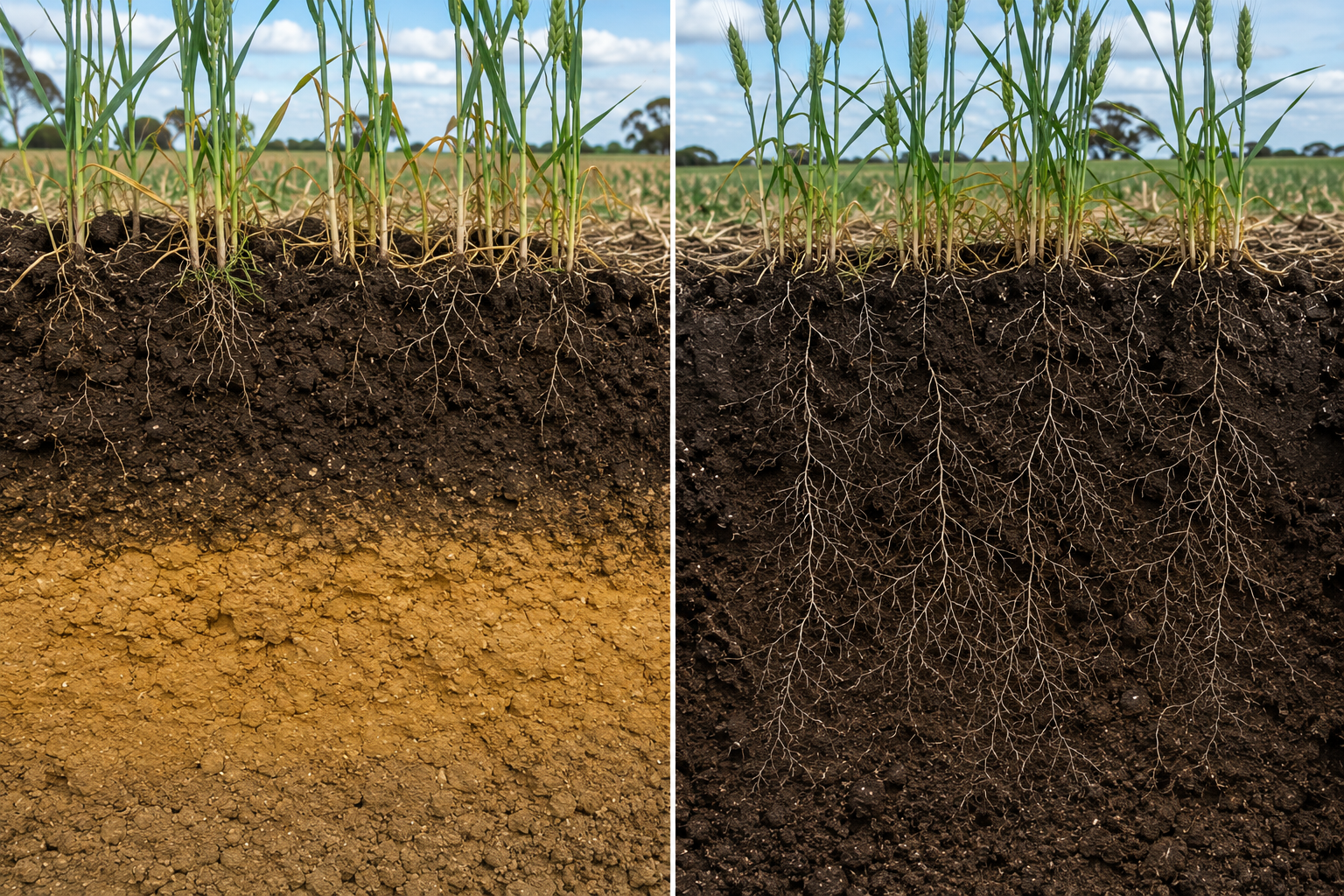
Aluminium toxicity travels with acidity, and it is worth treating as a problem in its own right. Once pH (CaCl₂) drops below about 4.8, aluminium held in clay minerals and hydroxides moves into soil solution as Al³⁺, where it is directly toxic to roots. It hits the root tip first: cell elongation stalls, then cell division, so root growth slows or stops at the depth where aluminium becomes toxic. The plant can look fine above ground while its roots are shut out of subsoil water and nutrients. That is why acid subsoils usually show up as a moisture or nutrition problem: the water stress is real, it's just not the cause.
We measure pH and exchangeable aluminium together at each depth increment, because surface pH tells you very little about what is underneath it. Two paddocks with similar topsoil pH can carry completely different aluminium loads below 10 cm. Exchangeable aluminium is a proxy rather than a direct measure of what roots experience, and tolerance varies between crops, so we read it against depth, pH and the rotation to work out whether aluminium is actually limiting rooting depth on that paddock or sitting behind a more pressing constraint.
Soil acidity is an ongoing process. Nitrogen cycling from ammonium fertilisers, organic acid release from roots, and alkalinity removed in harvested grain all push pH down every season, and continuous cropping keeps it moving. The acidification front works downward over decades, so profiles end up stratified: the top few centimetres can sit at pH 6 or above from residual surface lime while the 5 to 15 cm zone falls to pH 4.0 to 4.8, which is exactly where seed and starter fertiliser go. Standard 0 to 10 cm sampling averages the two and hides it. In WA, the problem runs deeper than in most cropping regions, well past 30 cm in many profiles, and lime alkalinity moves down slowly enough that surface application can take years to reach it, if ever, under low-rainfall conditions.
Aluminium toxicity travels with acidity, and it is worth treating as a problem in its own right. Once pH (CaCl₂) drops below about 4.8, aluminium held in clay minerals and hydroxides moves into soil solution as Al³⁺, where it is directly toxic to roots. It hits the root tip first: cell elongation stalls, then cell division, so root growth slows or stops at the depth where aluminium becomes toxic. The plant can look fine above ground while its roots are shut out of subsoil water and nutrients. That is why acid subsoils usually show up as a moisture or nutrition problem: the water stress is real, it's just not the cause.
We measure pH and exchangeable aluminium together at each depth increment, because surface pH tells you very little about what is underneath it. Two paddocks with similar topsoil pH can carry completely different aluminium loads below 10 cm. Exchangeable aluminium is a proxy rather than a direct measure of what roots experience, and tolerance varies between crops, so we read it against depth, pH and the rotation to work out whether aluminium is actually limiting rooting depth on that paddock or sitting behind a more pressing constraint.