
 Image 1 of 1
Non-wetting soils develop when waxy organic compounds from plant material, roots and microbes coat sand grains and stop water wetting them. It's a sand problem because coarse sand has very little grain surface area, so a small amount of that material covers a lot of it. It's also not permanent — repellence switches on below a critical soil water content and switches off once the soil is properly wet, which is why it bites hardest at the break and after small summer rain.
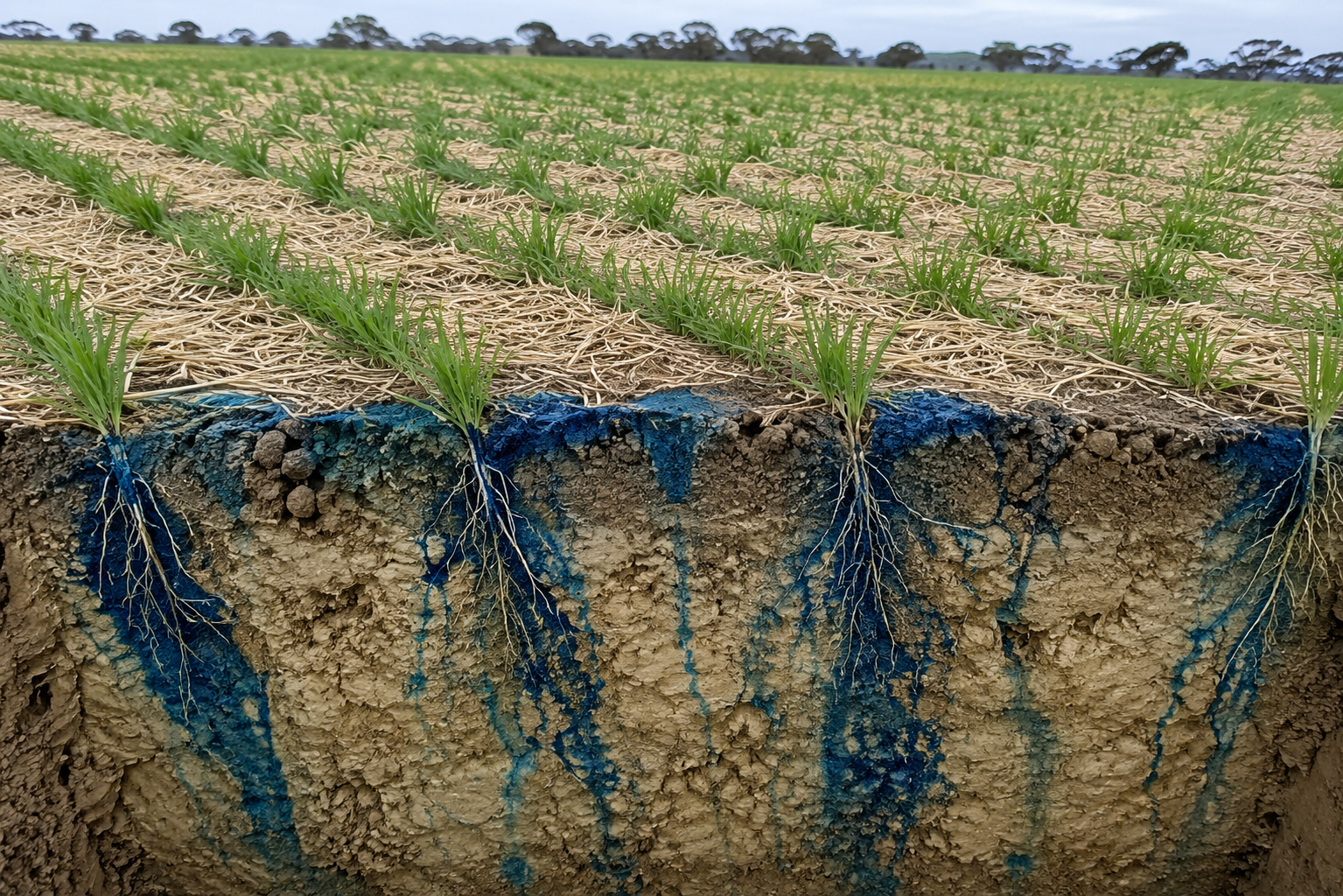
Water bypasses the dry repellent soil and runs down through whatever pathways it can find — seeding furrows, old root channels, wetter patches — so part of the profile wets to depth while the topsoil beside it stays dry. That gives you staggered establishment, and the weeds come up in waves with it. Anything that germinates late misses the pre-seeding and pre-emergent spray, and the herbicide itself concentrates in the wetted pathways rather than spreading evenly.
Mapping is required to understand where repellence sits, not assuming a paddock is uniform. Non-wetting tracks clay content closely, so soil type and spatial layers get us some of the way, but severity varies within a soil type at a finer scale than those layers resolve, so we measure it directly as well. From there, the options run from cheap to capital: on-row seeding to reuse last year's wet pathway, seeding at an angle to the slope so furrows hold water instead of shedding it, wetting agents — all low-risk but usually small and inconsistent in response — through to claying where clay is accessible, and soil inversion where the repellent layer needs burying outright. We match the spend to the severity of the problem, and not every problem requires a nuclear response.
Non-wetting soils develop when waxy organic compounds from plant material, roots and microbes coat sand grains and stop water wetting them. It's a sand problem because coarse sand has very little grain surface area, so a small amount of that material covers a lot of it. It's also not permanent — repellence switches on below a critical soil water content and switches off once the soil is properly wet, which is why it bites hardest at the break and after small summer rain.
Water bypasses the dry repellent soil and runs down through whatever pathways it can find — seeding furrows, old root channels, wetter patches — so part of the profile wets to depth while the topsoil beside it stays dry. That gives you staggered establishment, and the weeds come up in waves with it. Anything that germinates late misses the pre-seeding and pre-emergent spray, and the herbicide itself concentrates in the wetted pathways rather than spreading evenly.
Mapping is required to understand where repellence sits, not assuming a paddock is uniform. Non-wetting tracks clay content closely, so soil type and spatial layers get us some of the way, but severity varies within a soil type at a finer scale than those layers resolve, so we measure it directly as well. From there, the options run from cheap to capital: on-row seeding to reuse last year's wet pathway, seeding at an angle to the slope so furrows hold water instead of shedding it, wetting agents — all low-risk but usually small and inconsistent in response — through to claying where clay is accessible, and soil inversion where the repellent layer needs burying outright. We match the spend to the severity of the problem, and not every problem requires a nuclear response.